

(Sept. 9, 2013) A good object lesson can be learned from the recent hostage situation at the Ronald E. McNair Discovery Learning Academy outside of Atlanta, a situation that could easily have ended in a disaster.
 The set-up was much the same as the others in that an individual with severe mental illness, who was off his psychiatric medication and not receiving adequate treatment, gave in to his suicidal and homicidal impulses. What was different, and most certainly a miracle, was the resolution. No one was harmed, crisis was averted, lessons were learned and it all ended on a note of affirmation.
There is a particular corollary to this episode for this writer. When I was much younger and a patient in a psychiatric hospital, I became enraged by the behavior of another patient. It ended with me kicking the wall in frustration. I was immediately manhandled and carried to the seclusion wing where I was put in restraints on a bed in a bare room; sobbing the whole time.
If only someone had sat me down and talked to me in a soothing manner and proffered some comfort, a great deal of trouble and fuss would have been saved. I would not have been traumatized and the nurses would have not had to make the extra physical effort.
Young Michael Hill, who has a diagnosis of bipolar disorder, was not taking his medications and had literally plunged into the abyss, wanted to die and wanted to do it in the most spectacular way. He came to a school filled with about 600 children, armed with an A-K 47, and 500 rounds of ammunition. The scene was set for absolute horror. Yet, by the grace of God, he was intercepted by Antoinette Tuff, who was not even supposed to be in that particular chair in that particular room at that time.
What followed was a textbook example of how to talk to a mentally ill person who has lost all hope and is threatening to harm himself or others. The only tools she had were reassurance and love, something she was steeped in through her strong Christian faith. She was coached by a dispatcher, a nervous yet heroic Kendra McCray, but the bulk of what she said came from the heart and was wholly her own. In about the space of an hour, she gained Michael Hill’s trust, disarmed him, and helped him surrender to the police without incident. There was no bloodshed; merely relief and no little joy.
What heralded this resolution? It was certainly Ms. Tuff’s skills as a negotiator. But, it was more in her approach. She never lost sight of Michael Hill’s humanity and never let him lose sight of it also. She treated him with dignity and respect. She understood him and did not condemn him. She treated him courteously and not condescendingly. She addressed him as “Sir,” person to person, friend to friend. She displayed a rare compassion and she gave him a piece of herself, divulging her own struggles so that he would not feel so alone, that someone had been there and understood.
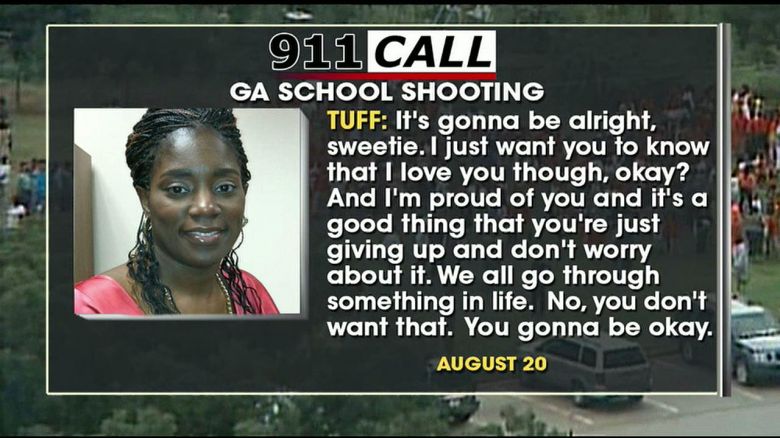
And in the end, it was her reassurance that brought the situation to a positive close, as she told Michael Hill, “It’s going to be all right, sweetie. I just want you to know I love you, though, OK? And I’m proud of you. That’s a good thing you’re just giving up and don’t worry about it. We all go through something in life.”
These comforting words have the simplicity of scripture and in their own humble way could compare to Paul’s 13th chapter on love in First Corinthians. Tuff transformed a negative into a positive and opened a window into the respective souls of each of us.
What can we draw from this episode? The way to defuse a situation like this one is to talk softly and reason with the agitated individual. Do not slight him or patronize him. Most certainly, don’t railroad him coming out with guns blazing as the police are wont to do. His symptoms and the agony he is in are the most real and immediate things in his world. Talk to him and strive to discern his level. Show him love and care.
By following these simple rules, many a crisis can be averted. No one wants senseless violence, not least the suffering individual, but there is often a disconnect that makes it inevitable. Yet, by sensitive and kind words, discerning understanding, a calm approach, and a little help from above, many a desperate situation can have a safe and positive outcome. You just have to keep an open mind and a receptive heart.
BRANDON W. FITCH
Program Annotator, Cleveland Philharmonic
To comment, visit our Facebook page.
Visit our blog archive to read all our recent posts.