

(May 3, 2017) As the population of the United States grows, so grows the number of people living with schizophrenia, bipolar disorder and other serious mental illness - and the consequences of these individuals going without timely and effective treatment.
When US Census Bureau population data are updated each year, the Office of Research and Public Affairs (ORPA) applies National Institute of Health (NIMH) prevalence statistics for schizophrenia and severe bipolar disorder* to produce population estimates for these psychiatric conditions by state.
The Findings
Based on 2016 population numbers, the analysis found the following:
- 8.2 million U.S. adults had schizophrenia or severe bipolar disorder at the combined NIMH prevalence rate of 3.3%.
- 3.9 million people with these diseases were untreated at any given time during the year.
- Schizophrenia affected 2.7 million US adults, based on a prevalence rate of 1.1%. Of them, nearly 1.1 million people were untreated.
- Severe bipolar disorder affected 5.5 million US adults, based on a prevalence rate of 2.2%. Of them, approximately 2.8 million were untreated.*
- As the state with the most adults, California's combined population with the two diseases was nearly 1 million adults, of whom an estimated 472,382 were untreated.
- As the state with the fewest adults, Wyoming's combined population with schizophrenia or severe bipolar was 14,738, of whom an estimated 6,996 were untreated.
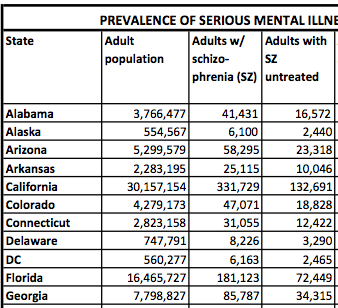
To put this in context, the 8.2 million combined population of people living with the two diseases is more than the entire adult populations of all but seven states. It is roughly the same number of persons in the US with attention deficit disorder, 1.5 times the population with Alzheimer's disease and nearly 8 times the number of individuals with human immunodeficiency virus. The prevalence of these serious mental illnesses is almost double the rate of autism and Down syndrome combined.
A chart containing every state's population and treatment prevalence estimates is published in the Evidence & Research section of the Treatment Advocacy Center website.
Variability in Treatment Rates
Greater variation in the prevalence of treatment is found when serious mental illness is defined more broadly, when treatment is defined by follow-up within more limited time periods, or if rates of treatment are analyzed for specific population subsets (e.g., individuals discharged from inpatient facilities, individuals refilling medication prescriptions).
"Serious mental illness and treatment prevalence," a May 2017 ORPA background paper, reports estimated treatment rates from nine different statistical sources or studies dating from the 1980s through 2016. By all the definitions and time parameters, however, at least one-third and up to approximately two-thirds of the population with serious mental illness was considered untreated.
Numbers alone do not capture the personal challenges, risks and suffering associated with schizophrenia and severe bipolar disorder, particularly when untreated. Consequences of non-treatment are known to include higher risk for homelessness, psychiatric boarding, arrest, incarceration, victimization, suicide, family violence and danger to others.
Individuals with untreated serious mental illness also are overrepresented within the population known as super utilizers - the relatively small number of people who make relatively frequent use of high-cost public services at enormous public expense. The Treatment Advocacy Center describes this phenomenon in our April 2017 report, A crisis in search of data: The revolving door of serious mental illness in super utilization.
*The NIMH estimates an additional 0.4% of the adult population has mild- to moderate-bipolar disorder.

Doris A. Fuller
Chief of Research and Public Affairs
References:
- Treatment Advocacy Center. (2017). "Prevalence of serious mental illness by state (2016)."
- National Institute of Mental Health. "Schizophrenia."
- National Institute of Mental Health. "Bipolar disorder among adults."
- Treatment Advocacy Center. (2017). "Serious mental illness and treatment prevalence."
- Treatment Advocacy Center. (2017). "Consequences of non-treatment."
- Fuller, D.A. et al. (April 2017). A crisis in search of data: The revolving door of serious mental illness in super utilization. Treatment Advocacy Center.
Follow ORPA on Twitter at @TACResearch.
Research Weekly is a summary published as a public service of the Treatment Advocacy Center and does not necessarily reflect the findings or positions of the organization or its staff. Full access to research summarized may require a fee or paid subscription to the publications.
To comment, please visit our Facebook page.