

'A tragedy that could have been prevented'
Treatment Advocacy Center endorses new IMD repeal bill named for New York City subway victim Michelle Alyssa Go
By: Treatment Advocacy Center News
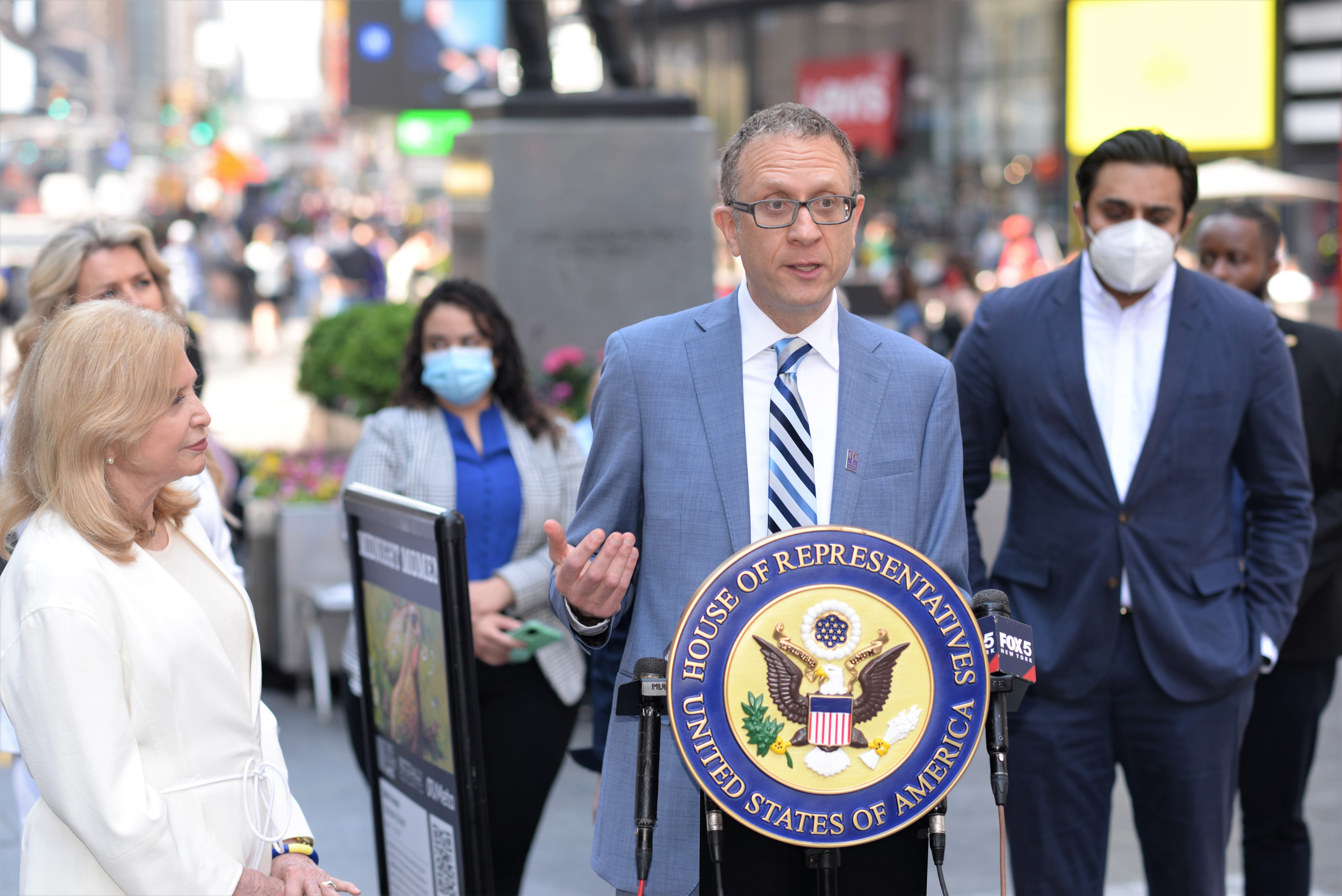 At a May 21 press conference held outside of the New York City subway station where Michelle Alyssa Go was killed in January by a 61-year-old man with signs of untreated schizophrenia, Treatment Advocacy Center Policy Director Brian Stettin joined Rep. Carolyn B. Maloney (D-N.Y.), and a host of city leaders and mental illness activists, including New York City Health Commissioner Ashwin Vasan and Kathryn Wylde, president and CEO of the Partnership for New York City, to call for the passage of new federal legislation to improve access to treatment for people with severe mental illness.
Under current federal law, Medicaid is prohibited from covering stays for patients between the ages of 21 and 64 who are receiving mental health or substance abuse treatment in a facility with more than 16 beds. This prohibition, also known as the Institution for Mental Disease (IMD) exclusion, has been in effect since Medicaid was created in 1965 and has resulted in people like the individual who killed Michelle Go not being able to access care.
The press conference in New York City’s Father Duffy Square was organized by Rep. Maloney, who last week introduced H.R. 7803, the Michelle Alyssa Go Act,to address this discriminatory policy, a relic of the failed move to deinstitutionalize psychiatric care in the last century.
The Michelle Alyssa Go Act will repeal the IMD exclusion and allow facilities with more than 16 beds to be reimbursed by Medicaid. This legislation also requires facilities to meet nationally recognized, evidence-based standards for mental health or substance use disorder programs.
Treatment Advocacy Center enthusiastically endorsed the bill, along with the American Society of Addiction Medicine, the National Alliance on Mental Illness, and the Partnership for New York City.
“Four months ago, a young Asian-American woman named Michelle Go was tragically killed when a man pushed her in front of a moving subway train. A daughter, a sister, a friend, and a member of the New York Junior League, Go worked at Deloitte and spent her free time helping women and children in at-risk communities as well as the homeless,” Rep. Maloney told reporters. “And what’s so devastating is that her death could have possibly been prevented, if only we had adequate mental health resources in New York City.”
“Go was killed by a 61-year-old man who showed signs of schizophrenia, but lacked access to adequate, consistent care.That is why I am introducing the Michelle Go Act. Under current federal law, Medicaid is prohibiting from paying for care in facilities that have more than sixteen beds,” said Rep. Maloney. “The Michelle Alyssa Go Act will repeal the IMD exclusion and allow facilities with more than 16 beds to be reimbursed by Medicaid.”
Passing the bill, she added, is a “no-brainer.”
Treatment Advocacy Center Policy Director Brian Stettin agreed.
“Congresswoman Maloney’s bill is desperately needed here in New York and across the nation,” Stettin, a former New York Assistant Attorney General, told the crowd. “Inpatient psychiatric beds and community-based residential treatment facilities are in distressingly short supply. This shortage largely explains why people like Martial Simon, walking the streets in florid psychosis and obvious need of treatment, have become a common sight in our cities.”
New York is never going to build the bed capacity needed to address the current crisis so long as it is dependent on general hospitals to provide those beds, Stettin stressed. In the case of private hospitals, “almost any other purpose they can find for their beds will be more profitable than inpatient psychiatric care. The economic incentive for them to ramp up on psych beds will never be there.” And in the case of city-owned hospitals, he said, there are too many competing priorities.
“That is why a meaningful solution can only lie in the expansion and establishment of hospitals dedicated exclusively to psychiatric care. And until we repeal the IMD exclusion, that simply is not economically viable for any potential operator.”
This tragic circumstance is not an “unintended consequence” of the IMD exclusion, Stettin stressed. The law’s very purpose is to discourage psychiatric care in inpatient settings, he said. “If that seems unimaginable, we have to remember how different circumstances were in 1965 when this policy was crafted.”
However, circumstances have changed “momentously” since the IMD exclusion was created, Stettin said. “Needs have changed. And it is high time for the law to change. So, Treatment Advocacy Center will work very hard to see this bill enacted.”
Read more about the IMD exclusion:
https://thehill.com/opinion/healthcare/561189-a-law-hindering-treatment-for-severe-mental-illness-must-be-repealed/
https://thehill.com/blogs/congress-blog/politics/589703-states-need-congress-help-repealing-a-law-that-hinders-treatment/